Pay for your fees and charges Pay Now

+233 (0) 243 211 345 info@ama.gov.gh GA-143-6657
Pay for your fees and charges Pay Now
+233 (0) 243 211 345 info@ama.gov.gh GA-143-6657


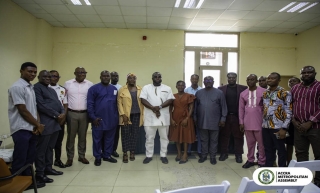
Members of the Accra Metropolitan Spatial Planning Committee and its Technical Sub-Committee have received training on the Land Use and Spatial Planning Act, 2016 (Act 925) and the Land Use and Spatial Planning Regulations, 2019 (L.I. 2384) to strengthen development control and promote orderly physical development in the city of Accra.
The capacity-building workshop, held on 19th November 2025 at the Naa Deidei Hall, brought together members of the committee and its Technical Sub-Committee who play key roles in spatial planning, permitting and enforcement within the Accra Metropolitan Assembly (AMA).
The Mayor of Accra, Hon. Michael Kpakpo Allotey, in an opening remark, urged participants to apply the knowledge gained from the training to tighten development control and curb unapproved physical development in the metropolis.
The Mayor stressed the need for strict compliance with permitting procedures, joint site inspections and close collaboration among the Physical Planning Department, Works Department and other relevant units, adding that consistent and professional handling of permit applications would enhance public trust, safeguard lives and property, and support revenue mobilisation.
He cautioned developers, contractors and landowners against commencing projects without valid planning and development permits, altering approved land uses or ignoring enforcement notices from the Assembly, and warned that such actions would attract sanctions including stop-work orders, demolition of illegal structures and possible prosecution under the Land Use and Spatial Planning laws.
The acting chairperson of the committee Mr. Richard Oduro, who welcomed participants, said the workshop was organised to boost members’ understanding of Act 925 and L.I. 2384 for better spatial planning and development control adding that deepening knowledge of the legal framework was essential to improving the quality of decisions taken on land use, planning applications, and development permits.
He indicated that the training aimed to promote sustainable land use and human settlement development, improve participants’ grasp of the Land Use and Spatial Planning legal framework, strengthen committee members’ roles in the planning system, and ensure the judicious use of land in the public interest.
Madam Linda Amfoa from the Land Use and Spatial Planning Authority (LUSPA), in a presentation, took participants through the key provisions of the Land Use and Spatial Planning Act, 2016 (Act 925), explaining that the law provides the basis for a decentralised, plan-led system to guide land use and human settlement development across the country.
She indicated that to obtain a building permit, prospective developers must purchase and complete the appropriate development permit application forms and attach all required documents, such as a site plan that conforms to the approved local plan, architectural and structural drawings, proof of land title or other authorisation to use the land, and, where applicable, technical reports on issues like environmental protection, fire safety, traffic impact, geotechnical and hydrological conditions.
She added that after completing the forms, the applicant was required to pay the processing fee, submit the full application to the Physical Planning Department, which serves as the Secretariat of the Spatial Planning Committee, and obtain an official acknowledgement of receipt within seven days.
She explained that the application would be forwarded to the Technical Sub-Committee for review, followed by a joint site inspection within 14 days to assess accessibility, susceptibility to flooding, availability of utilities, adjoining land uses and the general suitability of the site.
According to her, the Technical Sub-Committee was expected to submit its report and recommendations to the Spatial Planning Committee within 21 days of receiving the application adding that based on these recommendations, the Committee may grant, defer or refuse the application.
Where an application is approved, she said, the applicant must pay the prescribed permit fees after which the Physical Planning Officer and the Works Engineer endorse the approved plans and issue the relevant Planning Permit or Development Permit Certificate, together with a Land Use Certificate, for collection at the Physical Planning Department.
 09.Dec.2025

The Accra Metropolitan Assembly (AMA) is one of the Two Hundred and Sixty-One (261) Metropolitan, Municipal and District Assemblies (MMDAs) in Ghana and among the Twenty-Nine (29) MMDAs in the...Read More...
H72, Independence Avenue, Kinbu Garden
Digital Address: GA-143-6657
P. O. Box GP 385, Accra Central, Accra, Ghana
©Copyrights 2025 Accra Metropolitan Assembly. All rights reservedDeveloped by Akorsetec